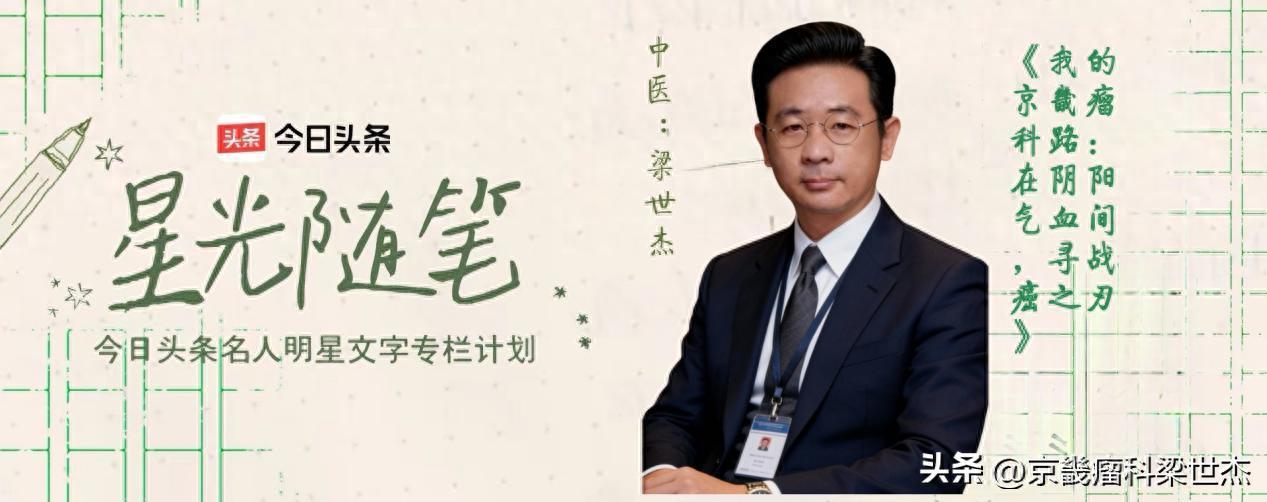
我的京畿瘤科路:在陰陽氣血間,尋戰癌之刃
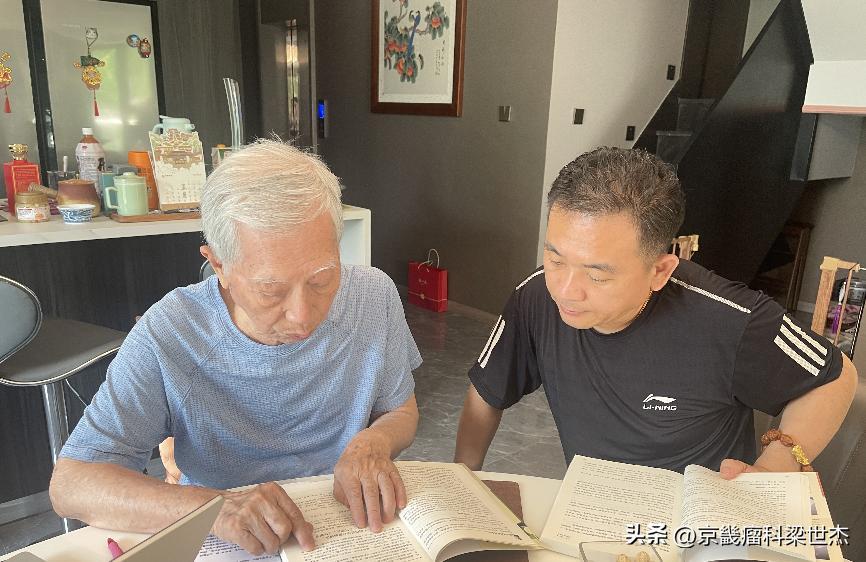
我常常想,我這條從河北涿鹿鄉間走到京畿之地的行醫路,起點或許並非在醫學院的課堂,而在更早之前——在跟隨舅公(舅爺)於鄉野間辨識百草的年歲裏,在爺爺舌下取栓,明辨陰陽(金精玉液二穴)的教誨中,在《黃帝內經》那句“正氣存內,邪不可幹”第一次撞入心扉的瞬間。後來醫學院校畢業10餘年後,我係統師從首都醫科大學附屬北京中醫醫院肝病科陳勇主任,有幸成爲國醫大師關幼波、焦樹德學術思想的第三代傳人。前輩們將“十綱辨證”與“治病重脾腎”的思想刻入我的臨證血脈,但我深知,面對“癌”這座當代醫學的險峯,僅有傳承遠遠不夠,必須在亙古的智慧與殘酷的現實之間,劈開一條自己的路。
這條路的第一塊里程碑,立在2015年。那一年,我發明的“治療肺癌的中藥三花五子六白散”獲得了國家發明專利授權。這個方子的源頭,可追溯至2005年秋在石家莊的一次偶然機緣,我從一位山東平原縣民間抗癌中醫處得見清代《方外奇方》所載的“青龍丸”。古方精悍,如一把塵封的利劍。我依循自己的理解,以藏雪蓮花、金銀花、藏紅花爲“三花”清解熱毒,以五倍子、葶藶子等“五子”與白朮、白花蛇舌草等“六白”共奏化痰散結、健脾祛溼之功,再加入全蠍、蜈蚣等蟲類藥深入絡脈,攻堅剔邪。這是我的第一次系統“亮劍”,我希望它能成爲刺向肺癌的一柄複合式兵器。
然而,現實的複雜性很快讓我意識到,單一兵器的勝利是脆弱的。我發表於2017年的《古方青龍丸治療中晚期肺癌20例》可視爲一次實戰記錄,但更深的觸動來自其後:古方中某些確有療效但具毒性的藥材,在今日嚴格的藥事管理下已難覓蹤影;一些曾被奉爲“消瘤聖藥”的藥材,也因種種原因被從現行《藥典》中移出。古人構築的“三駕馬車”陣型,在現代語境下驟然損折其二。這並非個例,它尖銳地揭示了一個核心困境:許多蘊藏古人智慧的驗方,因藥材變遷、理論隔膜,其效能正在不斷“衰減”。固守一方便是坐以待斃,我由此轉入更爲浩繁的求索。
於是,我開始了近乎貪婪的閱讀與整合。從金元四家到明清溫病,從傷寒經方到民間土法,我的讀書筆記積攢了尺許之厚。我係統研讀國醫大師周仲瑛教授“復法大方”治療腫瘤的思想,其針對複雜病機、多重證候而靈活組方的策略,讓我深受啓發。這不是簡單的疊加,而是有機的化合。我將這些年總結的多位國醫大師如周仲英、周岱翰、劉尚義的治癌觀點,加以體悟,連同二十餘年臨牀所見的病例,熔鑄於一爐,終於在2021年完成了《梁世傑中醫腫瘤治療學》一書(獲國家版權登記)。書中沒有神化任何一個“祕方”,而是老老實實整理了針對三十餘種常見癌症的數十首專病專方,它們來自古籍、來自名家、也來自我個人臨牀化裁的總結。我的目的,是試圖爲後來者搭建一個更具操作性的“武器庫”,而我自己,則必須向前再探一步,去思考這些武器背後的通用戰法。
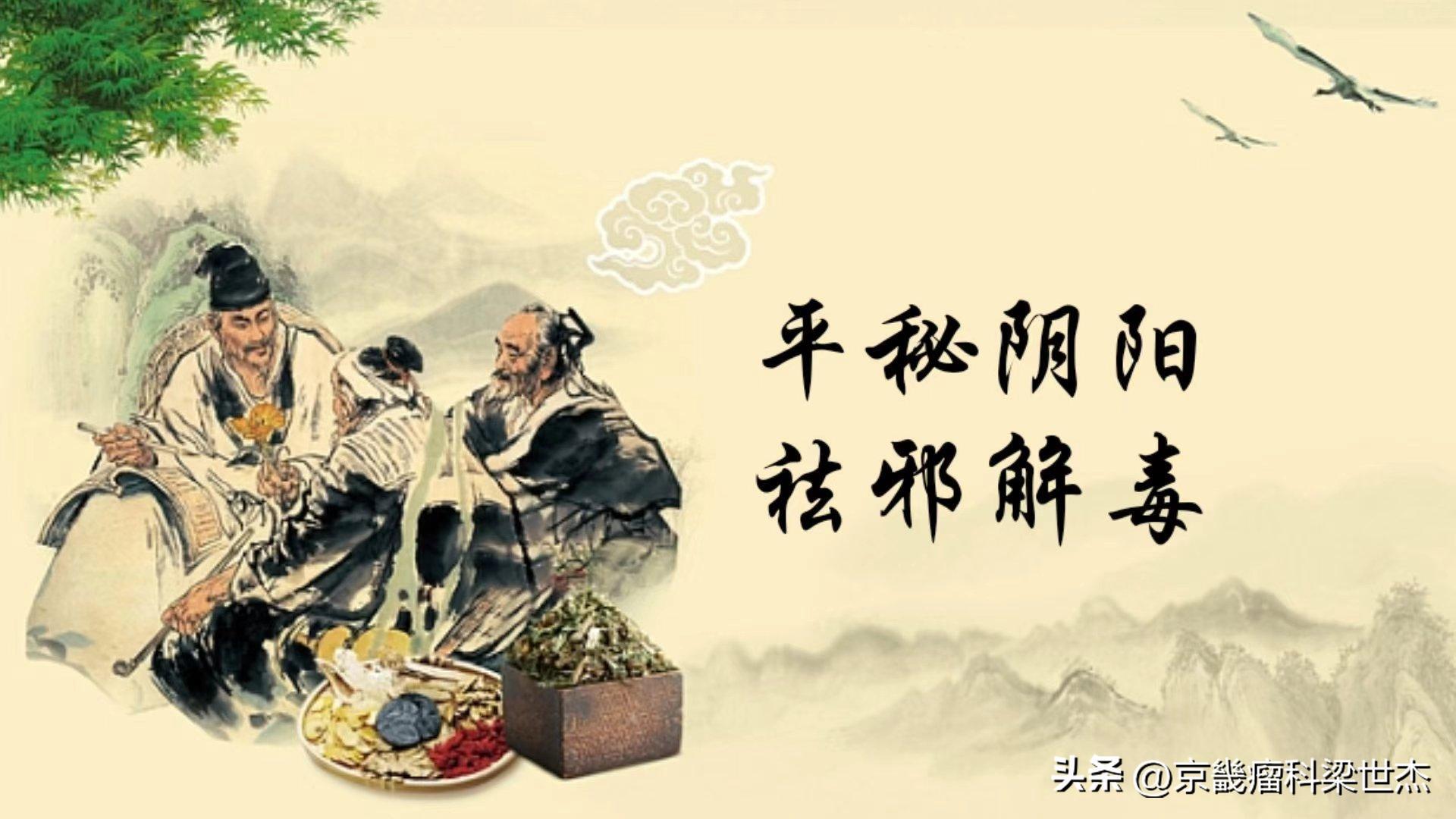
這便是“平祕陰陽,祛邪解毒”八字理論的由來。它源自我對癌症本質的觀察,我將其特性歸納爲五:潛伏性、猛烈性、頑固性、流注性、傷正性。這五大特性,如同一幅完整的癌病演進圖。“潛伏性”對應《內經》“邪之所湊,其氣必虛”,是正氣虧虛,邪氣內伏;“傷正性”則是癌毒肆虐,耗傷氣血陰陽的結果。因此,治療絕不能是“頭痛醫頭”的局部清剿。我的核心思路在於“平祕陰陽”——通過調和臟腑、補益氣血,重建人體內環境的穩定與平衡,如同鞏固一座城池的防禦。在此基礎之上,再以“祛邪解毒”爲矛,用清熱解毒、化痰散結、活血化瘀之法,精準打擊癌毒。
我尤爲關注“癌前病變”這一關鍵窗口期。例如,面對西醫認爲逆轉困難的“萎縮性胃炎伴重度腸化生”,我常以《傷寒論》大柴胡湯爲基礎進行加味,疏利肝膽、通瀉脾胃鬱熱。不少患者在調理後,胃腸鏡複查可見明顯改善。對於越來越多的“肺結節”人羣,我亦依據辨證,採用軟堅散結、宣肺通絡的方藥干預,許多患者的結節得以控制或縮小。這些實踐讓我堅信,中醫的“治未病”思想在腫瘤防治鏈的前端,擁有不可替代的戰略價值。
然而,理論與臨牀之間,橫亙着巨大的信任鴻溝。我深知,在腫瘤這樣的領域,空談理論無異於紙上談兵。因此,我給自己和團隊立下了一條鐵律:追求確定性的療效。我對醫學界那句著名的“有時去治癒,常常去幫助,總是去安慰”持有保留態度。這句話在臨終關懷中充滿人文溫度,但若將其泛化爲整個醫療行爲的“擋箭牌”,則可能消解醫生追求治癒技術的根本動力。《靈樞·邪氣臟腑病形》將醫生分爲上工、中工、下工,其標準是“十全九”、“十全七”、“十全六”的治癒率。我認爲,一名合格的中醫,至少應力求“十全六”的基準。這意味着,我們必須讓治療方案在患者身上產生可感知的積極變化——疼痛減輕、食慾恢復、體力增加、影像學穩定甚至好轉。
爲此,我積極借鑑現代醫學的評價體系。例如,在針對晚期非小細胞肺癌的聯合治療中,參考類似“參術扶正抗癌湯”聯合放化療的臨牀研究思路,我們在扶正祛邪方劑的應用中,不僅關注症狀改善,也會參考患者卡氏評分(KPS)的生活質量變化,乃至血清腫瘤標誌物、T細胞亞羣等免疫指標的動態。這不是“中醫西化”,而是爲了讓古老醫學的療效,能在一個更廣譜的語境下被清晰認知與驗證。當一位被預估生存期僅數月的晚期患者,通過中藥調理實現了長期“帶瘤生存”,且生活質量尚可時,那份生命的尊嚴,便是對這套戰法最有力的註腳。
從河北基層衛生院到立足北京,我這二十年的“京畿”行醫路,看的雖非全是腫瘤,但重症大病最爲刻骨銘心。我把自己逼成了一個“雜家”,也逼着中醫腫瘤學思考更根本的問題。腫瘤治療,是一場發生在人體內部微小宇宙的殘酷戰爭。我所致力的,是運用中醫的系統觀,努力理解這個宇宙失衡的法則(病機),然後以草木金石爲兵將,以複方大方爲陣圖,以“平祕陰陽”築城牆,以“祛邪解毒”出奇兵。
路漫漫其修遠。古方或許會蒙塵,藥材或許會變遷,但中醫認識生命、調和陰陽的哲學內核歷久彌新。我輩所能做,亦所當做的,便是做一個誠實的“修路工”與“實戰者”,在經典與現代、堅守與創新之間,爲更多在黑暗中跋涉的生命,鑿刻出一級級可供攀援的臺階。這,便是我自居“京畿瘤科”的全部初衷與求索。
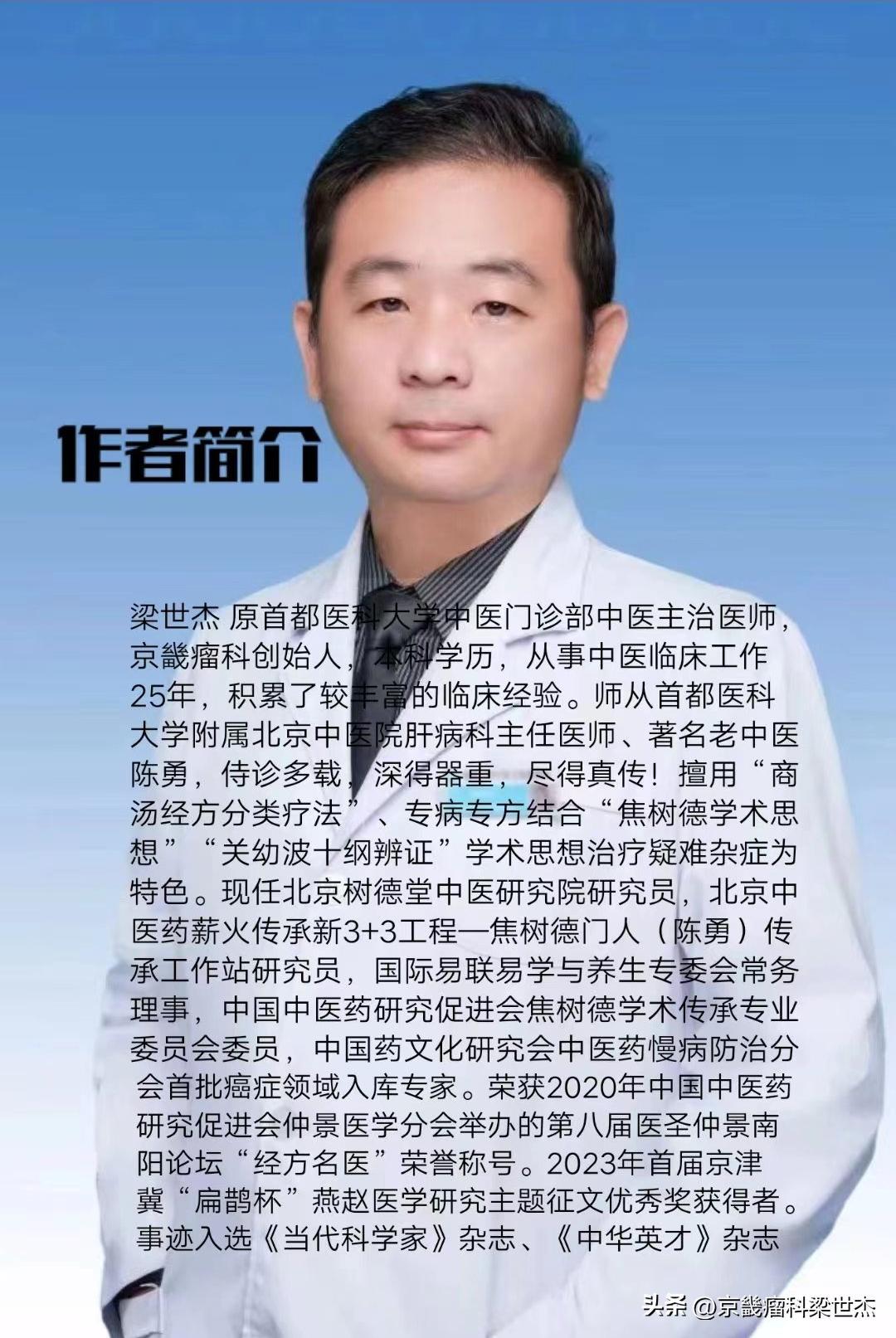
作者簡介:梁世傑 原首都醫科大學中醫門診部中醫主治醫師,京畿瘤科創始人,本科學歷,從事中醫臨牀工作25年,積累了較豐富的臨牀經驗。師從首都醫科大學附屬北京中醫院肝病科主任醫師、著名老中醫陳勇,侍診多載,深得器重,盡得真傳!擅用“商湯經方分類療法”、專病專方結合“焦樹德學術思想”“關幼波十綱辨證”學術思想治療疑難雜症爲特色。現任北京樹德堂中醫研究院研究員,北京中醫藥薪火傳承新3+3工程—焦樹德門人(陳勇)傳承工作站研究員,國際易聯易學與養生專委會常務理事,中國中醫藥研究促進會焦樹德學術傳承專業委員會委員,中國藥文化研究會中醫藥慢病防治分會首批癌症領域入庫專家。榮獲2020年中國中醫藥研究促進會仲景醫學分會舉辦的第八屆醫聖仲景南陽論壇“經方名醫”榮譽稱號。2023年首屆京津冀“扁鵲杯”燕趙醫學研究主題徵文優秀獎獲得者。事蹟入選《當代科學家》雜誌、《中華英才》雜誌。
My path in the field of gynecological oncology: Navigating between yin, yang, qi, and blood to seek the blade that can combat cancer.
Often, I think about my journey as a practitioner, which began in the countryside of Zhuolu, Hebei Province, and eventually led me to the heart of the capital region. Perhaps this journey did not start in the classrooms of a medical school, but rather much earlier – during my years of accompanying my maternal grandfather (my great-grandfather) in the fields to identify various herbs, learning from him about removing blockages from under my great-grandfather’s tongue and understanding the principles of yin and yang (the acupoints of Jinjin and Yuye) from my grandfather’s teachings. It was during that moment when I first grasped the phrase from the Huangdi Neijing, “The righteous qi resides within; the evil cannot affect it.” After completing my studies in a medical school more than a decade later, I formally studied under Chen Yong, the director of the Hepatology Department at Beijing Hospital Affiliated to Capital Medical University. I was fortunate to become the third generation of disciples for the scholarly ideas of Guo Youbo and Jiao Shu-de, the masters of traditional Chinese medicine. The elders instilled in me the concepts of the “Ten Principles of Diagnosis” and the importance of treating diseases by strengthening the spleen and kidneys. However, I am well aware that, in the face of the formidable challenges posed by “cancer,” mere inheritance is not enough; one must carve out one’s own path between ancient wisdom and harsh reality.
The first milestone on this road was established in 2015. That year, my invention, “Treatment of Lung Cancer with Traditional Chinese Medicine: Sanhua Wu Zi Li Bai San,” received a national invention patent. The origins of this formula can be traced back to an accidental encounter in Shijiazhuang in the autumn of 2005, where I came across the “Qinglong Pill” described in the Qing Dynasty’s “Fang Wai Qi Fang.” This ancient formula is powerful, akin to a long-forgotten sword. Based on my understanding, I used Snow Lotus Flower, Forsythia, and Saffron as the “three flowers” to clear heat and detoxify, combined with “five seeds” such as Euphorbia cerifera and “six whites” like Atractylis lanceolata and Scutellaria barbata to promote expectoration, resolve phlegm, tonify the spleen, and remove dampness. I then added insects like Scorpion and Centipede to penetrate the network of blood vessels and eliminate pathogenic factors. This was my first systematic “sword-wielding” effort, and I hoped it would become a composite weapon aimed at lung cancer.
However, the complexities of reality soon made me realize that the victory of a single weapon was fragile. My publication in 2017, “The Treatment of 20 Cases of Advanced Lung Cancer with Ancient Formula Qinglong Pill,” can be seen as a record of a real-world experiment. But what struck me even more profoundly was the fact that certain herbs in ancient formulas, which were indeed effective but also toxic, are now difficult to find under today’s stringent pharmaceutical regulations. Some herbs once revered as “miracle cures for tumors” have also been removed from the current Pharmacopoeia for various reasons. The “three-horse carriage” formation devised by the ancients has suddenly lost two of its components in modern contexts. This is not an isolated case; it starkly reveals a core dilemma: many formulas that embody the wisdom of the ancients are experiencing a continuous “decline” in efficacy due to changes in herbs and theoretical gaps. Sticking to one approach is tantamount to waiting for disaster to strike; this prompted me to embark on a more extensive quest.
As a result, I embarked on an almost voracious process of reading and integration. From the Four Great Masters of Jin Yuan to the Ming and Qing Dynasties’ studies on febrile diseases, from the classical prescriptions of the Treatise on Febrile and Miscellaneous Diseases to folk remedies, my reading notes accumulated to the thickness of a few inches. I systematically studied Professor Zhou Zhongying’s ideas on using “reformulated formulas” to treat tumors, which emphasized the flexibility of formulating treatments based on complex pathological mechanisms and multiple syndromes. This approach greatly inspired me. It was not simply about adding things together; it was about forming an organic whole. I synthesized the cancer-fighting perspectives of various renowned Chinese medical masters, such as Zhou Zhongying, Zhou Daihan, and Liu Shangyi, along with the clinical cases I observed over twenty years. Finally, in 2021, I completed the book “Liang Shijie’s Chinese Cancer Treatment” (which has been registered for national copyright). The book does not glorify any “secret formulas”; instead, it meticulously presents dozens of specialized formulas tailored for over thirty common types of cancer, derived from ancient texts, masterworks, and my own clinical adaptations. My goal was to create a more practical “weapons arsenal” for future practitioners, while I myself had to venture further ahead to contemplate the underlying universal strategies behind these weapons.
This is the origin of the eight-character theory of “balancing Yin and Yang, dispelling evil and detoxifying.” It stems from my observations of the nature of cancer, which I have summarized into five characteristics: latent, intense, stubborn, flowing, and damaging to the vital forces. These five characteristics form a comprehensive picture of the progression of cancer. “Latent” corresponds to the concept in the “Inner Canon” that “where there is an accumulation of evil, the corresponding qi will be deficient,” indicating a state of deficiency of vital qi and the presence of hidden evils. “Damaging to the vital forces” represents the rampant spread of cancer toxins, leading to the depletion of qi, blood, and yin and yang. Therefore, treatment must not be a localized effort of “treating the head when there’s a headache.” My core approach is “balancing Yin and Yang” – by harmonizing the organs, replenishing qi and blood, and restoring the stability and balance of the human body’s internal environment, akin to fortifying a city’s defenses. On this foundation, we can then use “dispelling evil and detoxifying” as our weapon, employing methods such as clearing heat and detoxifying, resolving phlegm and knots, and promoting blood circulation to precisely target and eliminate cancer toxins.
I pay particular attention to the critical window period for “pre-cancerous lesions.” For example, when dealing with “atrophic gastritis with severe metaplasia,” which Western medicine considers difficult to reverse, I often base my treatment on the Da-Xiao-Bu Decoction from “Treatise on Febrile and Miscellaneous Diseases” and use it to promote the flow of bile and gallbladder, and to clear the stagnation of heat in the spleen and stomach. After undergoing treatment, many patients have seen significant improvements in their results from gastrointestinal endoscopies. For the growing number of individuals with “lung nodules,” I also use diagnostic methods to intervene with formulas that soften hard masses, disperse adhesions, and promote lung function and blood circulation. Many of these patients have been able to control or reduce the size of their nodules. These experiences have convinced me that the concept of “preventive medicine” in traditional Chinese medicine holds irreplaceable strategic value at the forefront of the cancer prevention and treatment chain.
However, there exists a significant gap of trust between theory and clinical practice. I am well aware that in fields like oncology, mere theoretical discussions are akin to mere speculation. Therefore, I have established a firm rule for myself and my team: to pursue definitive and effective results. I have reservations about the famous phrase in medicine, “Sometimes to cure, often to alleviate, always to comfort.” This phrase is imbued with humanistic warmth in palliative care, but if it is generalized as a “shield” for the entire realm of medical practice, it may undermine the fundamental motivation of doctors to pursue curative techniques. The “Xue Li” text, which categorizes doctors into superior, intermediate, and inferior practitioners based on their cure rates of “ten complete cases out of ten,” “nine complete cases out of ten,” and “six complete cases out of ten,” respectively, suggests that a competent traditional Chinese medicine practitioner should strive to achieve the benchmark of “six complete cases out of ten.” This implies that we must ensure that our treatment plans lead to perceptible positive changes in patients – reduced pain, restored appetite, increased physical strength, stable or even improving imaging results.
To this end, I actively draw inspiration from the evaluation systems of modern medicine. For example, in the context of combined treatment for advanced non-small cell lung cancer, we reference clinical research approaches similar to those involving the combination of “San-Shu Fu-Zheng Anti-Cancer Decoction” with radiotherapy and chemotherapy. In the application of tonifying and eliminating malignancy formulas, we not only focus on symptom improvement but also consider changes in the patient’s Karnofsky Performance Status (KPS) for quality of life, as well as dynamic indicators such as serum tumor markers and T-cell subsets. This is not about “Westernizing traditional Chinese medicine”; rather, it is about allowing the efficacy of ancient medicine to be clearly understood and validated within a broader context. When a patient with advanced cancer, whose estimated survival time was only a few months, achieved long-term “tumor-bearing survival” through herbal therapy and maintained a relatively good quality of life, the dignity of that life serves as the strongest testament to this approach.
From the grassroots health clinics in Hebei Province to establishing a foothold in Beijing, my twenty-year journey as a practitioner in the “capital region” has involved treating a variety of conditions, although not exclusively tumors. However, the treatment of severe and critical illnesses has been the most memorable. I have pushed myself to become a “jack-of-all-trades” and have compelled traditional Chinese medicine oncology to consider more fundamental issues. Tumor treatment is a brutal war taking place within the microscopic universe of the human body. What I strive to do is to apply the systemic view of traditional Chinese medicine, strive to understand the laws governing this cosmic imbalance (pathogenesis), then use herbs, minerals, and stones as soldiers, employ compound formulas as battle plans, build walls with the principles of balancing yin and yang, and employ unconventional tactics to eliminate evil and detoxify.
The path ahead is long and arduous. Ancient methods may become obscured, ingredients may change, but the philosophical core of traditional Chinese medicine’s understanding of life and the harmonization of yin and yang remains vibrant and ever-relevant. What we can and should do is to be honest “road workers” and “practitioners,” bridging the gap between classics and modernity, adhering to tradition while embracing innovation, and carving out steps that others can climb in the darkness. This is the very purpose and pursuit that drives me to identify myself as a practitioner of “the Beijing Tumor Clinic.”
Author profile: Liang Shi-jie was a chief physician of traditional Chinese medicine at the Traditional Chinese Medicine Outpatient Clinic of Capital Medical University. He was the founder of Jingyi Tumor Clinic. He holds a bachelor’s degree and has been engaged in clinical work in traditional Chinese medicine for 25 years, accumulating extensive clinical experience. He studied under Chen Yong, a renowned senior traditional Chinese medicine practitioner at the Hepatology Department of Beijing Traditional Chinese Medicine Hospital affiliated to Capital Medical University. Over the years, he gained great respect and acquired genuine expertise. He specializes in using the “Shang Tang Classic Classification Therapy” and combining specific treatments for specific diseases with the “Jiao Shu-de Academic Thought” and the “Guan You-bo Ten-Principle Diagnosis” approach to treat complex medical conditions. He is currently a researcher at the Beijing Shu-de-Tang Traditional Chinese Medicine Research Institute and a researcher at the Beijing New 3+3 Project for the Inheritance of Traditional Chinese Medicine – Jiao Shu-de’s Disciples (Chen Yong) Heritage Workstation. He is a Standing director of the International Yi-lian Yi-xue and Health Preservation Committee and a member of the Committee for the Inheritance of Jiao Shu-de’s Academic Thought of the China Research Promotion Association for Traditional Chinese Medicine. He is also a member of the inaugural Cancer Expert Pool of the China Cultural Research Association for Traditional Chinese Medicine’s Prevention of Chronic Diseases. He was awarded the title of “Expert in Classic Prescriptions” at the Eighth Nanyang Forum of the Zhang Zhongjing Medical Division of the China Research Promotion Association in 2020. In 2023, he won the Excellence Award in the First Beijing-Tianjin-Hebei “Bian Que Cup” Yan-Zhao Medical Research Theme Essay Competition. His achievements have been featured in the magazines “Contemporary Scientists” and “China’s Elite”.